The Architect Is Now the Bottleneck
When code gets written in hours instead of weeks, the constraint doesn't disappear. It moves. And it moved to us.
Following up on my previous post I argued that we won't stop coding but we'll stop typing. This is the follow-up question nobody asked me but everybody should: if agents can produce working code in hours, then what becomes the new constraint?
Spoiler. It's the Architects.
The queue inverted
For twenty years, the software delivery pipeline had a predictable shape. Design was fast, implementation was slow. An architect could sketch a solution in an afternoon, and then teams would spend weeks or quarters building it. Design decisions queued up behind implementation capacity. We hired more engineers to widen that bottleneck. We invented agile ceremonies to manage the queue. Entire org charts were built around the assumption that writing code is the expensive part.
That assumption just died.

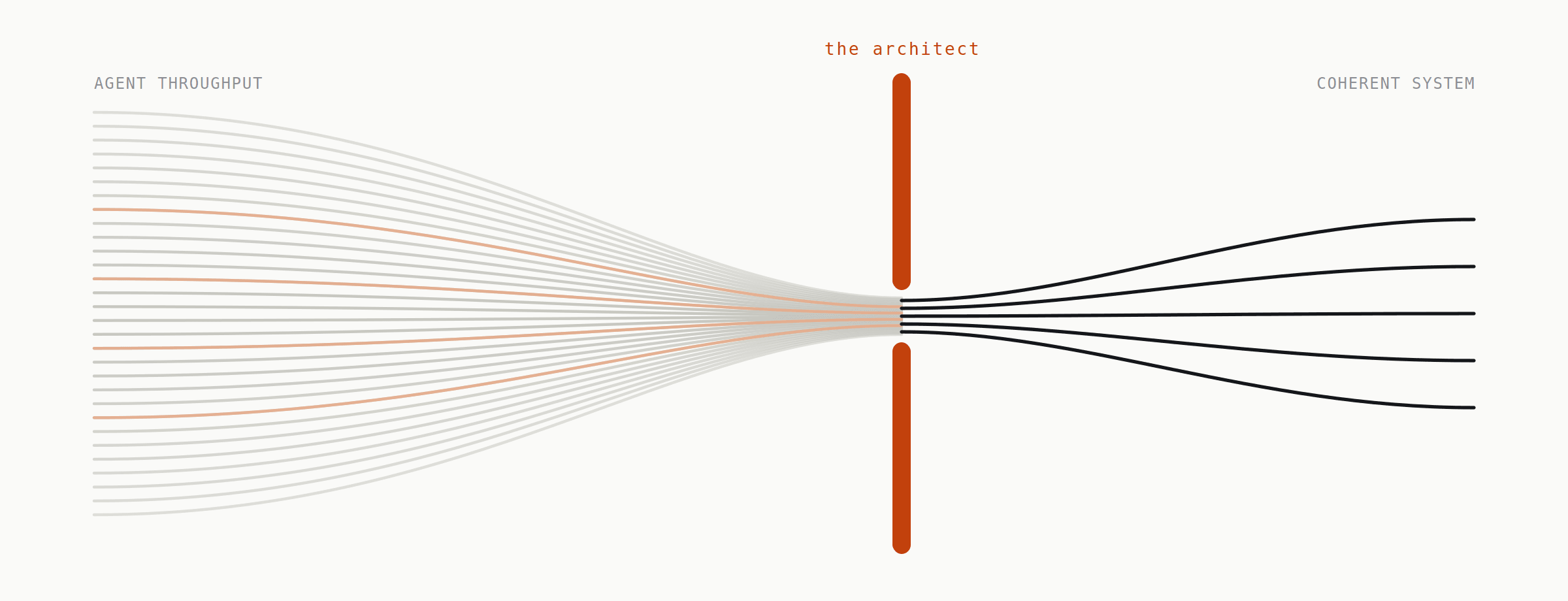
Today, an agent can take a well-specified task and ship a tested implementation before your standup ends. Implementation, once was the slowest stage of the pipeline, is suddenly the fastest. But throughput of a pipeline is defined by its slowest stage. And the slowest stage now is the one that can't be parallelized by adding GPUs: deciding what to build, how to bound it, and whether what came back is correct.
That's design. That's review. That's architecture.
Being wrong at scale, revisited
The cost of producing code is collapsing. The cost of being wrong at scale is not. I keep coming back to this because it's the asymmetry that defines the whole era.
Here's what it looks like in practice. A bad architectural decision used to be expensive but slow-moving. If you picked the wrong service boundary, you'd feel the pain gradually, over months, as teams stepped on each other and the release failure rate increased. The slowness of implementation was, weirdly, a safety mechanism. It gave us time to notice we were digging in the wrong direction!
Agents remove that safety mechanism. A wrong decision now gets implemented thoroughly, consistently, and fast - across every service, with tests that verify the wrong behavior and documentation that explains it beautifully. You don't get months to notice. Within a day or two, the pull request arrives.
The blast radius of a design mistake used to be limited by how slowly humans could execute it. Now the blast radius is limited only by how quickly a human catches it. That human is usually the architect.
Three places the bottleneck actually bites
1. Specification. Agents are extraordinary at filling in the gaps when requirements are unclear, which is precisely the problem.
Every gap is filled with a reasonable assumption, and an assumption isn’t always correct. The quality of an AI agent’s output depends on the quality of the context and constraints you provide: business rules, non-functional requirements, edge cases, and what must never change. Defining these clearly is architecture work, and it can’t be skipped. In fact, it becomes even more important. What used to be clarified in a quick conversation now has to be captured explicitly in the prompt or documentation. There is no hallway conversation anymore only a context window.
2. Review. When one engineer produced one PR a day, senior review was a manageable tax. But when a single engineer orchestrates multiple AI agents producing dozens of PRs every day, review becomes the bottleneck. The real risk isn’t that reviewers stop reviewing. It’s that they start approving changes too quickly.
Code can compile, pass every test, and still be architecturally wrong. It may introduce hidden coupling, violate a key design principle, create an unsafe retry pattern, or add technical debt that won’t surface until production. These issues rarely appear in the diff. They only become obvious when you understand the architecture and the system as a whole.
3. Coherence. This is the quiet one. Ten agents solving ten tickets will produce ten locally optimal solutions and a globally incoherent system. Three different error-handling conventions. Two new ways to publish events. A caching layer nobody asked for. Each PR is fine; the sum is entropy. Someone has to hold the line on the shape of the system, and that's not a task you can delegate to the things generating the entropy.
What we did last time the bottleneck moved
It's not only flashbacks. We've seen this movie. When manual testing became the constraint, we didn't hire armies of testers forever - we built CI and made testing infrastructure. When ops became the constraint, we didn't page sysadmins harder - we built platforms and made deployment self-service.
The pattern is always the same: Every time a human activity becomes the bottleneck, we turn it into infrastructure.
So the interesting question isn't "how do architects work harder." It's: what does architecture look like as infrastructure?
Some early answers I believe in:
- Executable constraints. Fitness functions, architecture tests, dependency rules that run in CI. If a rule matters, an agent should not be able to violate it and go green. "The architecture" stops being a Confluence page and becomes a failing build.
- Context as a first-class artifact. ADRs, conventions, and system invariants written for agent consumption - versioned, discoverable, loaded into every session. The teams getting the best agent output aren't better prompters; they have better-documented systems. Context is the new uptime.
- Tiered review. Not every change deserves the same inspection. Classify changes by blast radius - a copy tweak and a schema migration should not travel the same path. Let agents review the low-radius tier against your executable rules; spend human attention where being wrong is expensive.
- Smaller decision batches. If design is the constraint, apply the theory of constraints to it: reduce batch size. Decide less, more often, with faster feedback from real implementations - which, conveniently, agents can now produce as cheap throwaway prototypes.

The uncomfortable part
There's a career implication here that I'll say out loud: a lot of what we called "senior engineering" was actually fast, high-quality implementation. That skill hasn't become worthless, but its rareness premium is gone. What's rare now is the ability to specify precisely, to smell an unsound design in a clean-looking diff, and to keep a system coherent while its rate of change goes up 10x.
Those skills were always the essence of architecture. We just used to have time to develop them slowly, across years of implementation work. That runway is shorter now, and the demand is higher.
The bottleneck is us. The good news is that bottlenecks get the most attention, the most tooling, and the most leverage. The bad news is that bottlenecks that don't scale get replaced by infrastructure that does.
I'd rather build that infrastructure than be replaced by it.